

Digital Care Concierge
Designing an AI-Powered Native Mobile Experience for a Connected Patient Journey
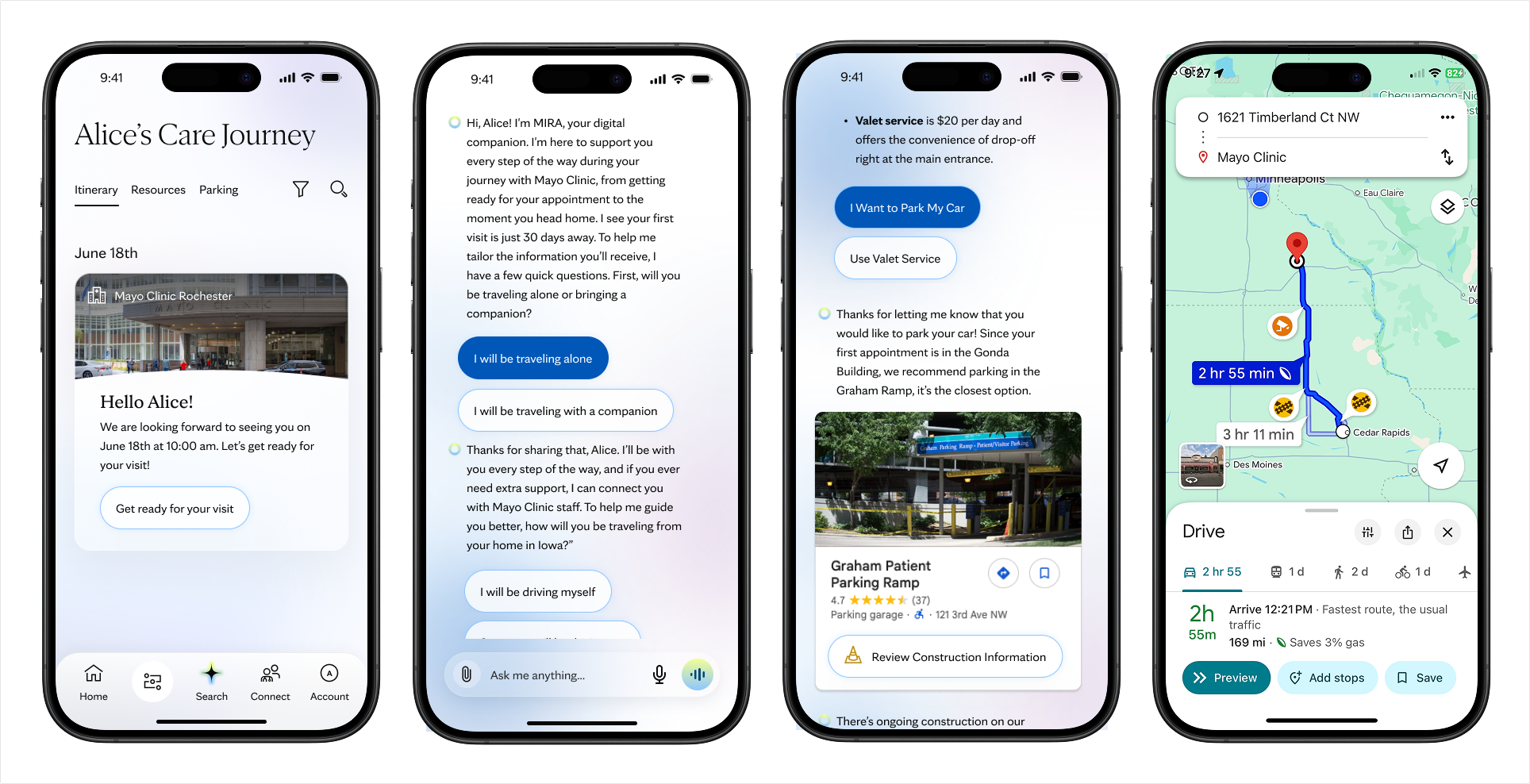
Select screens showing the patient itinerary, AI assistant, parking information, and navigation experience
My Role
Product Designer
Overview
Digital Care Concierge is an AI-enabled experience designed to support patients throughout their care journey. By anticipating patient needs and delivering relevant guidance at the right moment, the experience aims to reduce uncertainty, simplify complex logistics, and create a more connected path to care.
My work focused specifically on the pre-arrival and arrival phases, exploring how the experience could better prepare and guide patients before and during their visit.
Problems We Were Solving
Fragmented experiences: Patients encounter disconnected touchpoints between scheduling an appointment and arriving for care.
Scattered information: Critical details about preparation, navigation, appointments, and available services are spread across multiple touchpoints, making them difficult to find and understand.
Uncertainty and cognitive load: Patients may arrive feeling unprepared or overwhelmed during an already challenging experience.
My Contribution
I partnered with my design lead, Product, subject matter experts, and stakeholders across Mayo Clinic to define and design the patient experience.
My responsibilities included:
Creating a patient persona to ground the experience in user needs
Collaborating with Product and stakeholders on requirements and feature definition
Defining and refining the patient journey, including pain points, questions, needs, and opportunities
Conducting stakeholder interviews to understand patient services and the broader service ecosystem
Creating wireframes, high-fidelity visual designs, and interactive prototypes
Exploring how AI could provide proactive support in a useful, intuitive, and human-centered way
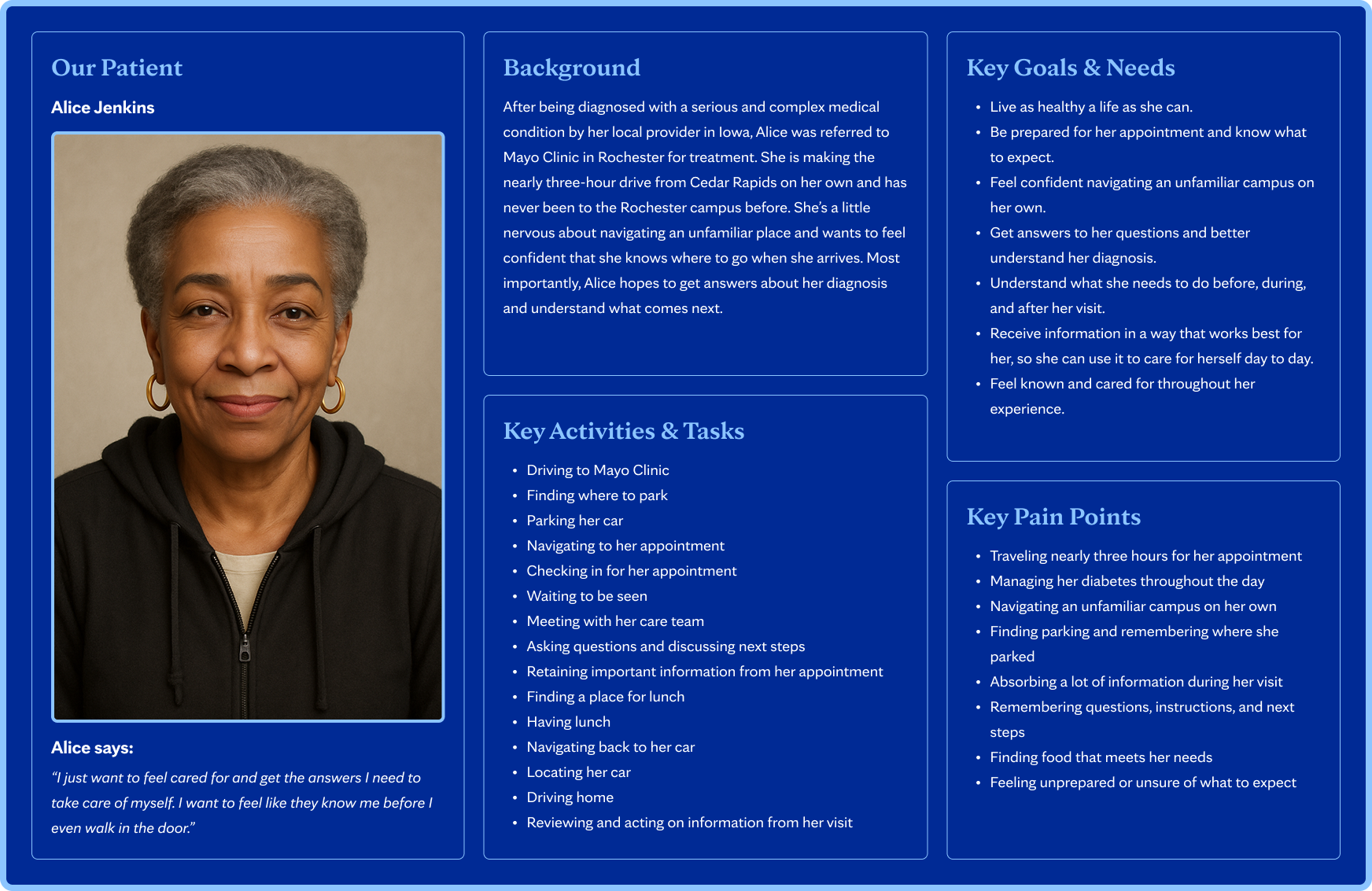
Alice, a persona representing a patient traveling to Mayo Clinic for specialized care
Understand
Patient Journey Mapping
To understand the experience holistically, we mapped the patient care journey from pre-arrival through departure, then focused more deeply on the pre-arrival and arrival phases. This helped us identify moments of friction, uncertainty, unmet needs, and opportunities for more proactive support.
We focused on answering key questions:
What information do patients need, and when do they need it?
How can we reduce the cognitive burden of planning and navigating a visit?
How can we set expectations?
Where can AI proactively assist rather than simply react?
How might we help patients feel more informed, supported, and confident throughout their care journey?
These questions informed both the product vision and experience strategy.
Explore
Stakeholder & Ecosystem Research
I partnered with the product team to interview teams across Mayo Clinic that provide services to patients during their visit. These conversations helped us understand available resources, when patients might need them, and where the digital experience could proactively connect patients with relevant support.
Define
Experience Strategy
I developed the patient care journey in Miro, working with my design lead and Product to identify patient needs, pain points, questions, and opportunities across each stage. From there, I translated the journey into concepts and workflows, exploring how AI, navigation, information, and patient services could work together to provide more proactive support. I iteratively refined the experience as product requirements evolved and new stakeholder insights emerged.
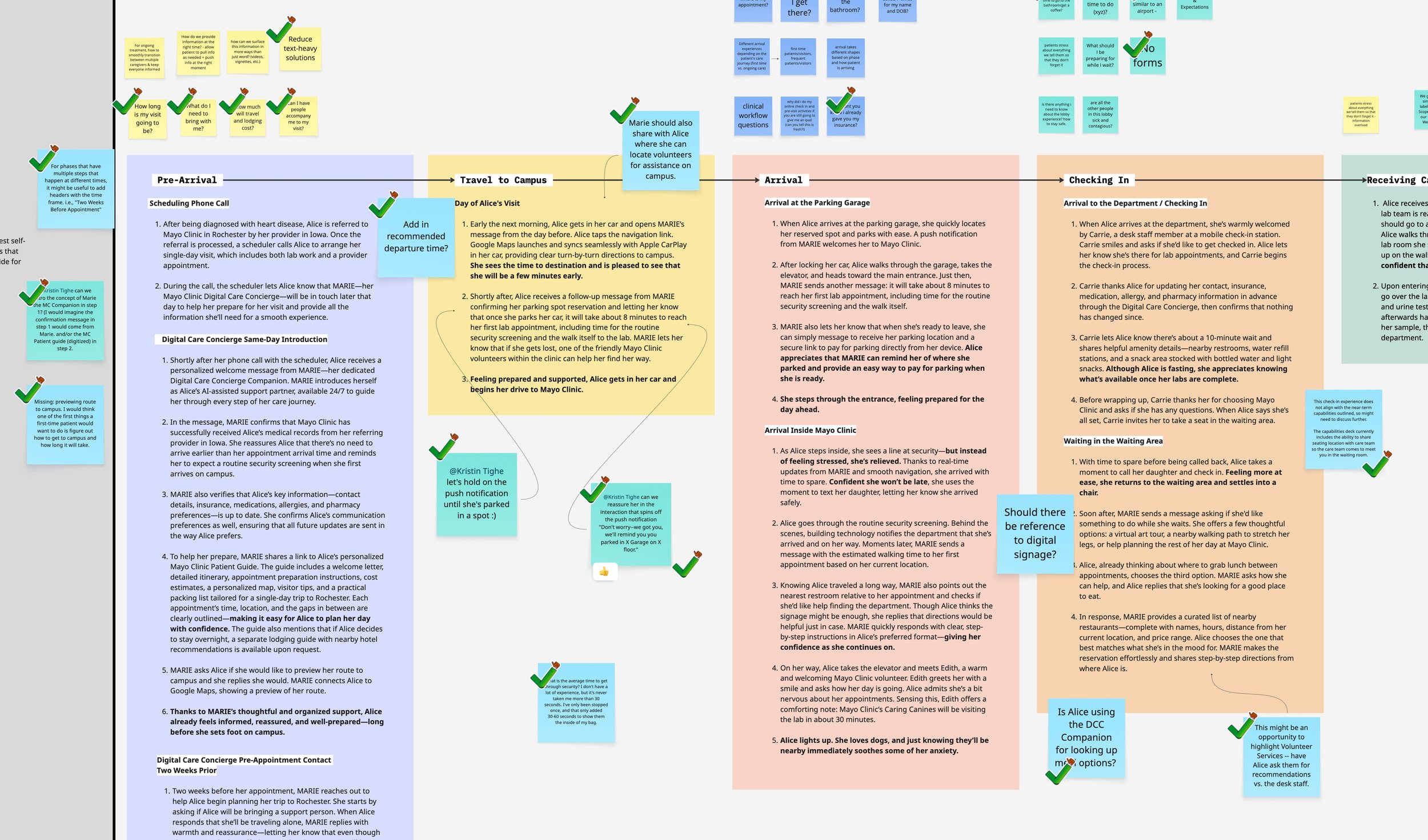
I developed the journey map in Miro and collaborated with stakeholders and Product to align patient needs and opportunities with product requirements
Design
From Concepts to Prototypes
My design lead and I worked together to translate the experience strategy into wireframes, exploring how itinerary information, navigation, patient resources, check-in, and AI-powered assistance could work together within a cohesive experience. We iterated from early concepts through high-fidelity visual designs and interactive prototypes in Figma, refining the experience as requirements and stakeholder feedback evolved.
Solution
Connected Care Navigation
We designed an AI-powered care navigation experience that provides personalized guidance before and during a patient's visit, with this phase focusing specifically on pre-arrival and arrival.
Key capabilities include:
Personalized pre-visit preparation and appointment guidance
Dynamic wayfinding and navigation
Streamlined, timely notifications
Real-time itinerary management
A reimagined digital check-in experience
Proactive recommendations and concierge services
Accessibility accommodations and support
Rather than requiring patients to manage multiple disconnected systems, the experience brings critical information and services together within a single guided journey.
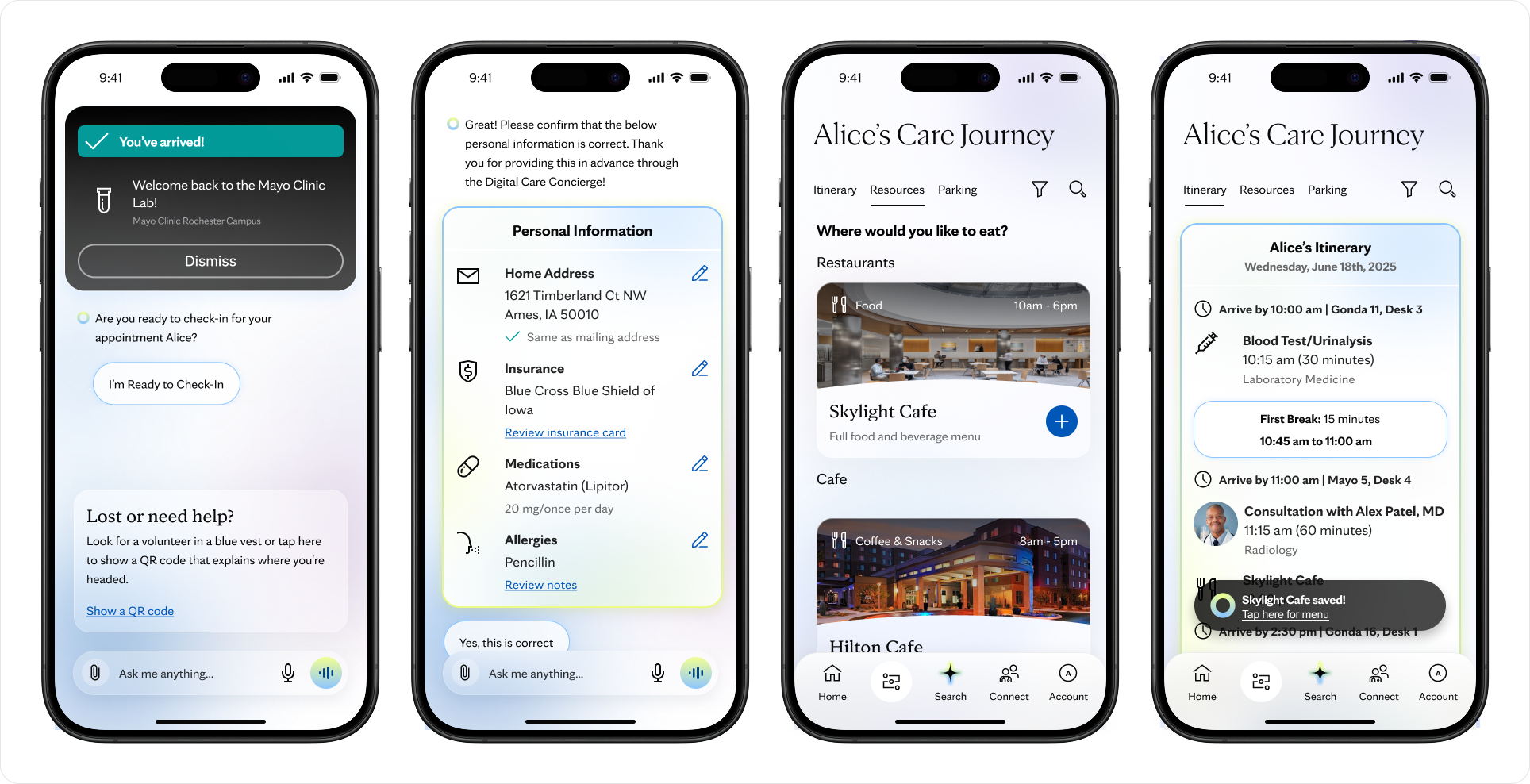
Select screens showing the reimagined check-in, patient resources, and personalized itinerary experience
Current Status
At the time of this case study, the first phase of Digital Care Concierge, the patient itinerary, was being evaluated through pilot testing with a beta group of patients.
What I Learned
This project deepened my understanding of the patient journey and the complex ecosystem that supports it. It also reinforced the importance of integrating AI thoughtfully, using technology to reduce friction and provide more personalized support without losing the human connection.
The people patients encounter throughout their care are part of the “magic” of Mayo. This project challenged me to imagine an innovative experience that uses technology to preserve and support that human connection rather than replace it.