

Digital Check-In
Creating a Seamless Omnichannel Arrival Experience
Project Snapshot
Role: Primary Product Designer
Platforms: Web • Native Mobile Apps • In-Clinic Kiosks
Team: Product • Engineering • Operational Leaders • Vendor Partners
Responsibilities: UX Strategy • Journey Mapping • Omnichannel Experience Design • Accessibility • Prototyping • Stakeholder Alignment
Focus: Maintaining and reimagining digital check-in across channels while also defining a future-state vision for a connected patient experience.
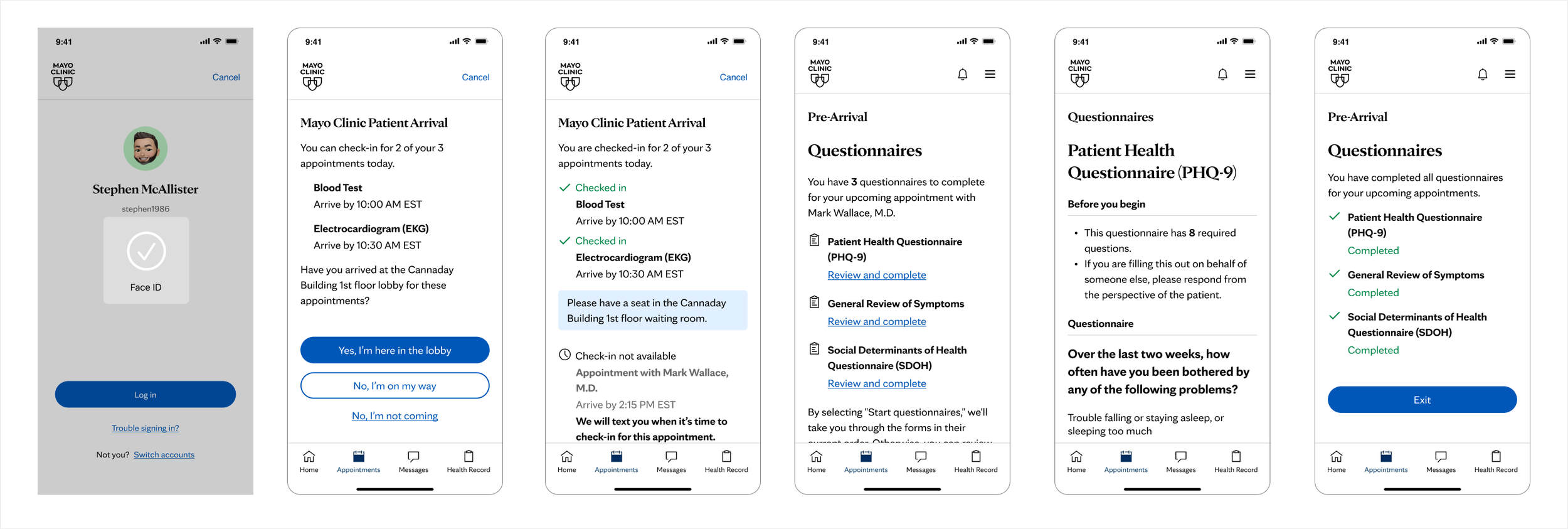
Select screens from the Digital Check-in future state mobile app experience
Role
Primary Product Designer
Overview
As the primary Product Designer for Digital Check-in, I led the design of patient check-in experiences across web, native mobile applications, and in-clinic kiosks. My work focused on creating a consistent, accessible experience regardless of how patients chose to engage, while balancing current platform constraints and defining a long-term vision for the future of digital check-in.
In addition to improving the existing experience, I partnered with cross-functional teams to design a future-state ecosystem that better connected digital and in-person touchpoints throughout the patient journey.
The Challenge
Digital check-in experiences were fragmented across channels and heavily influenced by the capabilities of a third-party vendor platform. While functional, the experience introduced friction for patients and did not always meet modern expectations for usability, accessibility, and transparency.
Key challenges included:
Inconsistent experiences across web, mobile, and kiosk channels
Limited accessibility and usability capabilities
Difficulty checking in for multiple appointments within a single experience
Lack of integrated communication between patients and care teams
Limited flexibility for completing required tasks, such as questionnaires and forms
Poor visibility into task expectations, effort, and progress
Limited transparency around how patient information was being collected and used
These limitations created unnecessary complexity at a point in the patient journey where clarity and confidence are especially important.
My Contribution
As the primary designer for Digital Check-in, I partnered with product managers, engineers, operational leaders, and vendor teams to improve the current experience while defining a long-term product vision.
My responsibilities included:
Leading UX strategy and design across web, mobile, and kiosk experiences
Identifying usability, accessibility, and workflow pain points
Creating journey maps, user flows, wireframes, and prototypes
Collaborating with vendor teams to understand platform capabilities and constraints
Partnering with operational stakeholders to align digital experiences with clinical and administrative workflows
Defining and visualizing a future-state omnichannel check-in experience
Design Approach
A significant challenge of this work was designing within the constraints of a vendor-managed platform while still advocating for the best possible patient experience.
To make informed design decisions, I worked closely with vendor partners to understand system limitations, upcoming platform changes, and opportunities for customization. At the same time, I collaborated with hospital operational teams to ensure that proposed solutions would not negatively impact existing workflows or create additional burden for staff.
For the future-state vision, I expanded beyond current constraints to explore how digital check-in could become a seamless experience spanning mobile, web, kiosks, and physical campus interactions. This required thinking holistically about how patients transition between digital and in-person experiences and identifying opportunities to reduce friction across the entire journey.
Vision & Design Strategy
We improved the existing experience through targeted usability and accessibility enhancements while simultaneously defining a future-state vision for digital check-in.
The future-state experience focused on:
A consistent check-in experience across all channels
Simplified management of multiple appointments
Flexible task completion options based on patient preference
Greater visibility into task progress and expectations
Improved communication between patients and care teams
Increased transparency around patient data usage
Better integration between digital interactions and on-campus experiences
By viewing check-in as part of a larger patient journey rather than a standalone transaction, we were able to identify opportunities to create a more connected and supportive experience.
Outcome
This work helped establish a strategic vision for a more unified and patient-centered check-in experience while continuing to improve the current state experience within existing platform constraints.
The project strengthened alignment across product, operational, and vendor teams and highlighted the capabilities needed to deliver a truly seamless omnichannel experience in the future.
For me personally, the project deepened my expertise in designing complex healthcare workflows, navigating third-party platform constraints, and balancing patient needs with operational realities across multiple channels and touchpoints.
Interactive mobile prototype of the Digital Check-In redesign on iOS, demonstrating two-way texting, identity verification and dynamic questionnaires.