

Digital Care Navigation
Guiding Patients Through Their Care Journey with AI-Powered Support
Project Snapshot
Role: Product Designer
Platforms: Mobile Application
Team: Product • Engineering • Subject Matter Experts • Stakeholders
Responsibilities: Patient Journey Mapping • Experience Strategy • UX/UI Design • Prototyping • AI Experience Design
Focus: Designing an AI-enabled care navigation experience that provides personalized guidance, reduces uncertainty, and supports patients throughout the pre-arrival and arrival journey.
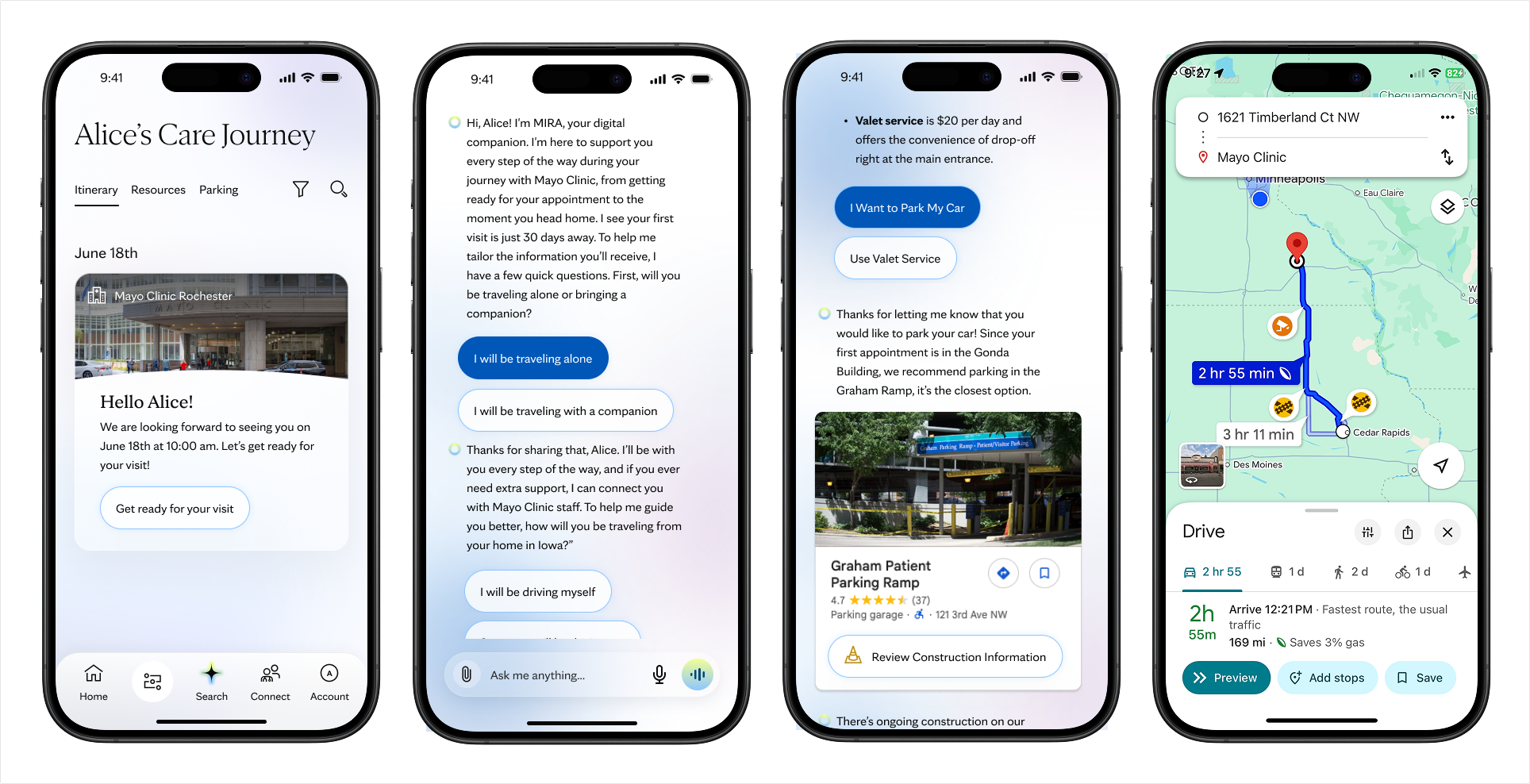
Select screens from the mobile app arrival experience
My Role
Product Designer
Overview
Digital Care Navigation is an AI-enabled experience designed to support patients throughout the pre-arrival and arrival journey. By anticipating patient needs and delivering relevant guidance at the right moment, the experience reduces uncertainty, simplifies complex logistics, and creates a more connected path to care.
The solution is currently being piloted with a beta group of patients.
The Challenge
Patients often encounter a fragmented experience between scheduling an appointment and arriving for care. Critical information is spread across multiple touchpoints, making it difficult to understand what to expect, how to prepare, where to go, and what services are available.
As a result, patients may arrive feeling unprepared, overwhelmed, or uncertain, creating unnecessary stress during an already challenging time.
My Contribution
As one of two designers on the project, I partnered closely with product managers, subject matter experts, and stakeholders to define the end-to-end patient experience.
My responsibilities included:
Defining and refining patient journey flows
Identifying pain points and opportunity areas across the pre-arrival and arrival experience
Collaborating on product requirements and feature definition
Writing and visualizing future-state user journeys
Creating wireframes, visual designs, and interactive prototypes
Helping shape how AI could be integrated in a way that felt useful, intuitive, and human-centered
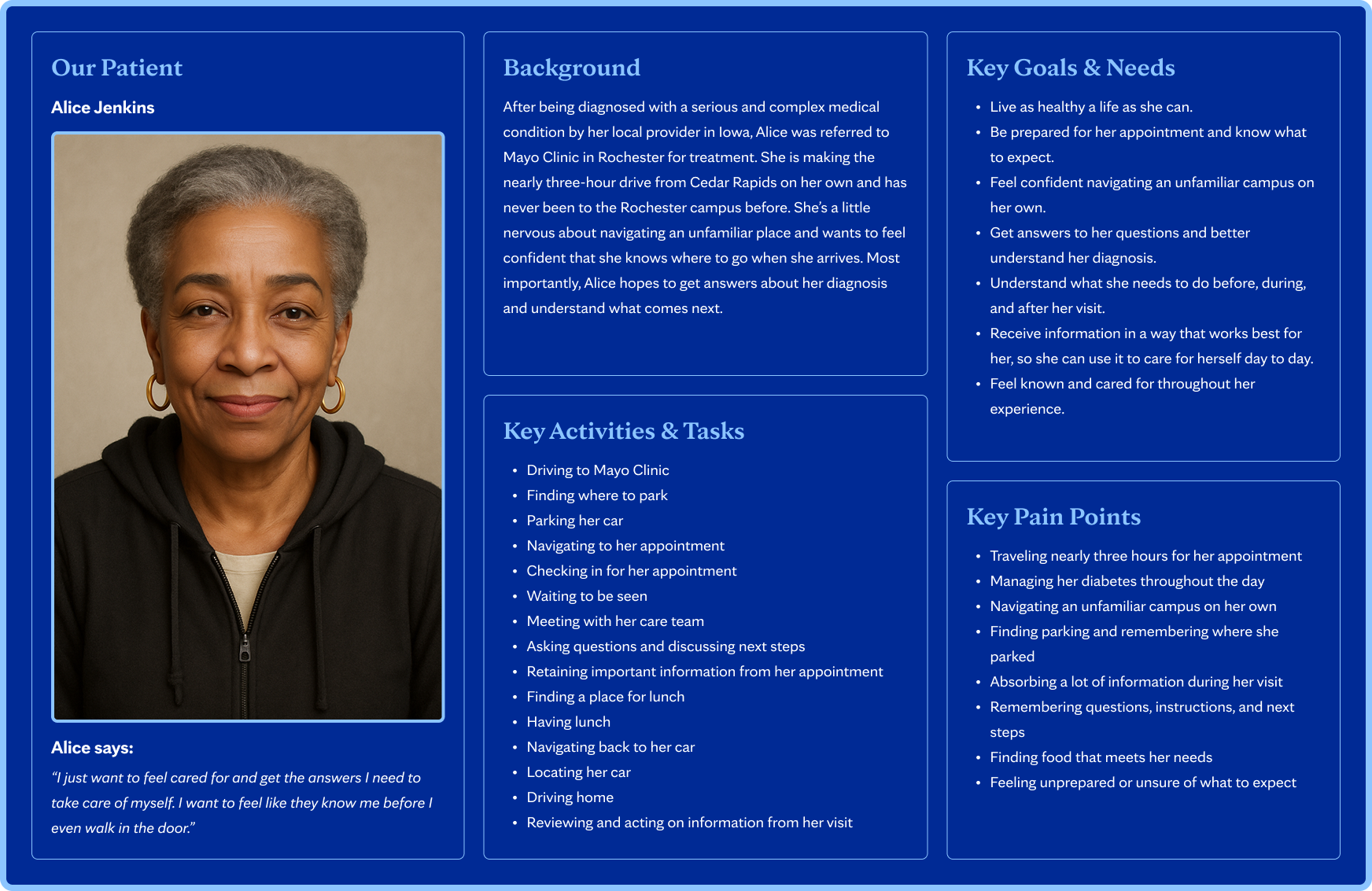
Alice, a persona representing a patient traveling to Mayo Clinic for specialized care.
Design Approach
To understand the experience holistically, we mapped the patient journey from appointment scheduling through arrival on campus. This process helped uncover moments of confusion, friction, and unmet needs.
We focused on answering key questions:
What information do patients need and when do they need it?
How can we reduce the cognitive burden of planning and navigating a visit?
Where can AI proactively assist rather than simply react?
How might we make patients feel more informed, supported, and confident throughout their journey?
These insights informed both the product vision and experience strategy.
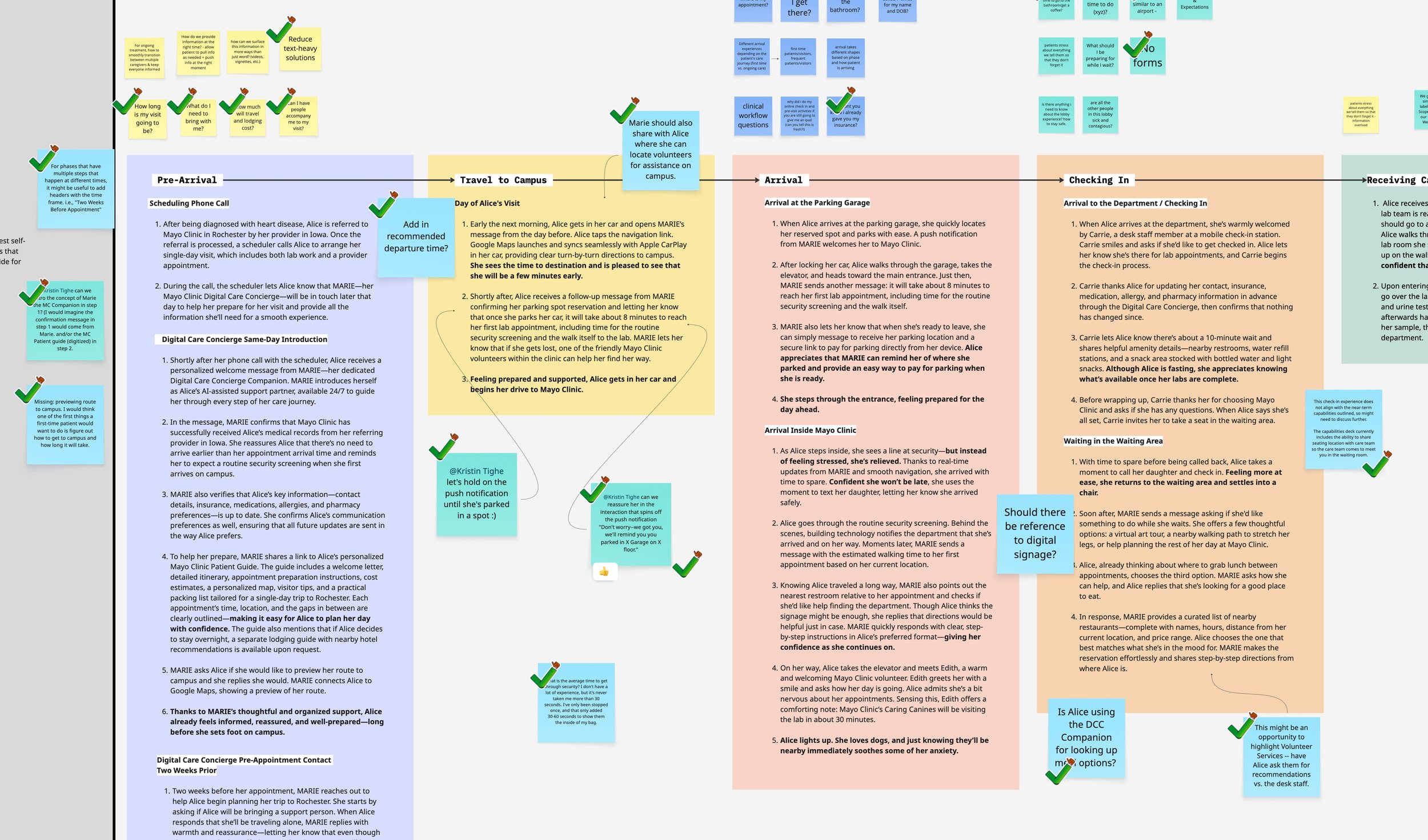
I developed the journey map in Miro and collaborated with the product team to align it with business requirements while identifying patient needs, pain points, and questions at each stage of the journey.
The Solution
We designed an AI-powered digital care navigation experience that delivers personalized guidance before and during a patient's visit.
Key capabilities include:
Personalized pre-visit preparation and appointment guidance
Dynamic wayfinding and navigation support
Real-time itinerary management
A streamlined, reimagined check-in experience
Proactive recommendations and concierge services
Automated accessibility accommodations and supports
Rather than requiring patients to manage multiple disconnected systems, the experience brings critical information and services together within a single guided journey.
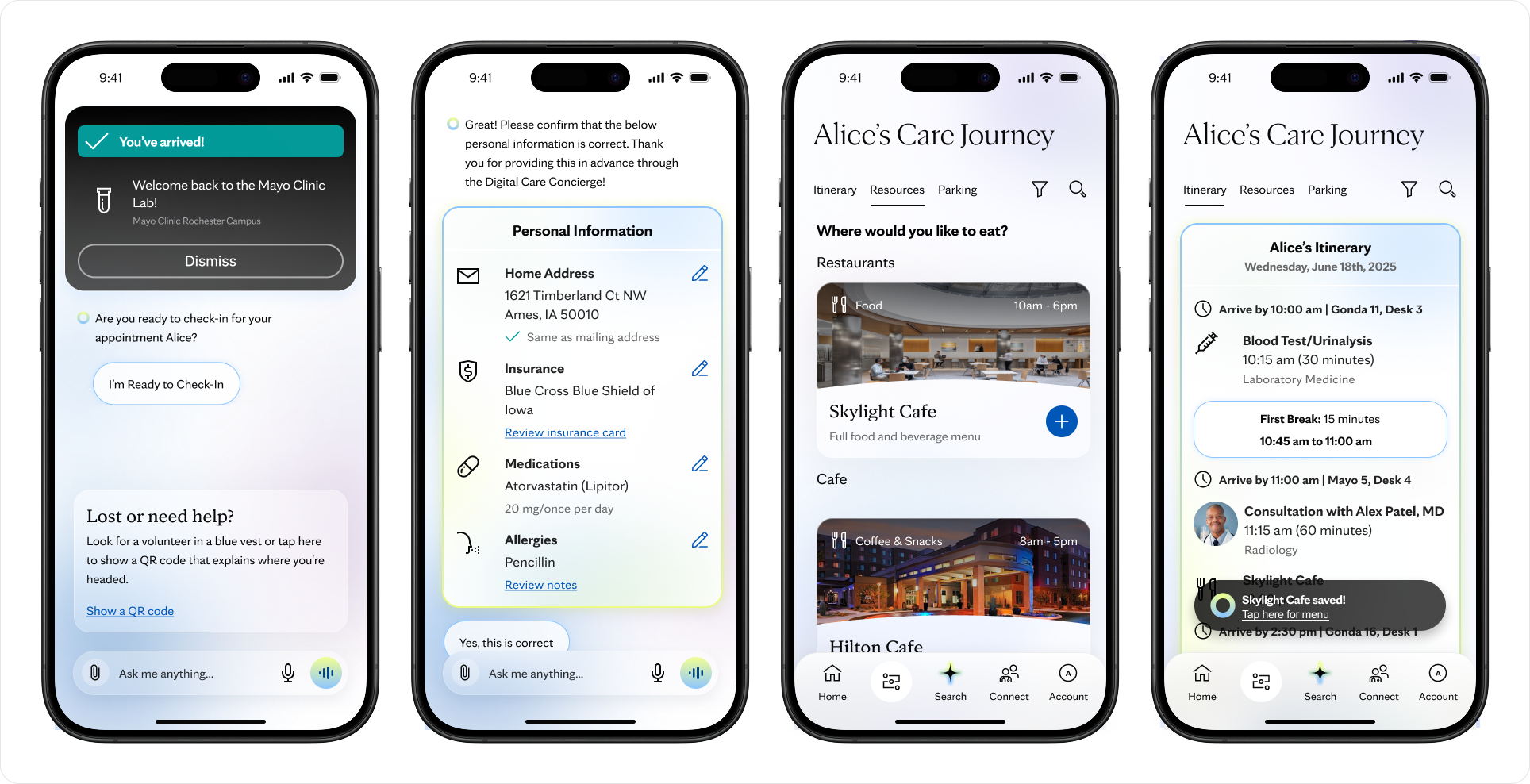
Select screens from the mobile app check-in and resources experience
Outcome & Current Status
The Digital Care Navigation experience is currently being evaluated through pilot testing with a beta group of patients.
This project deepened my understanding of the end-to-end patient journey and the complex ecosystem of services that support patients. It also provided an opportunity to explore how AI can be thoughtfully integrated into healthcare experiences to reduce friction, improve confidence, and create more personalized support at scale.