

Care Team Navigator
Designing Intelligent Clinical Workflows & Employee Experiences
Project Snapshot
Role: Product Designer
Platforms: Web Application • Mobile Application
Team: Product • Engineering • Clinicians • Employees • Stakeholders
Responsibilities: AI Experience Design • User Research Synthesis • Journey Mapping • Workflow Design • UX/UI Design • Prototyping • Design Systems
Focus: Designing AI-enabled experiences that transform complex information into actionable insights for clinicians and employees while supporting two distinct user groups within a unified platform.
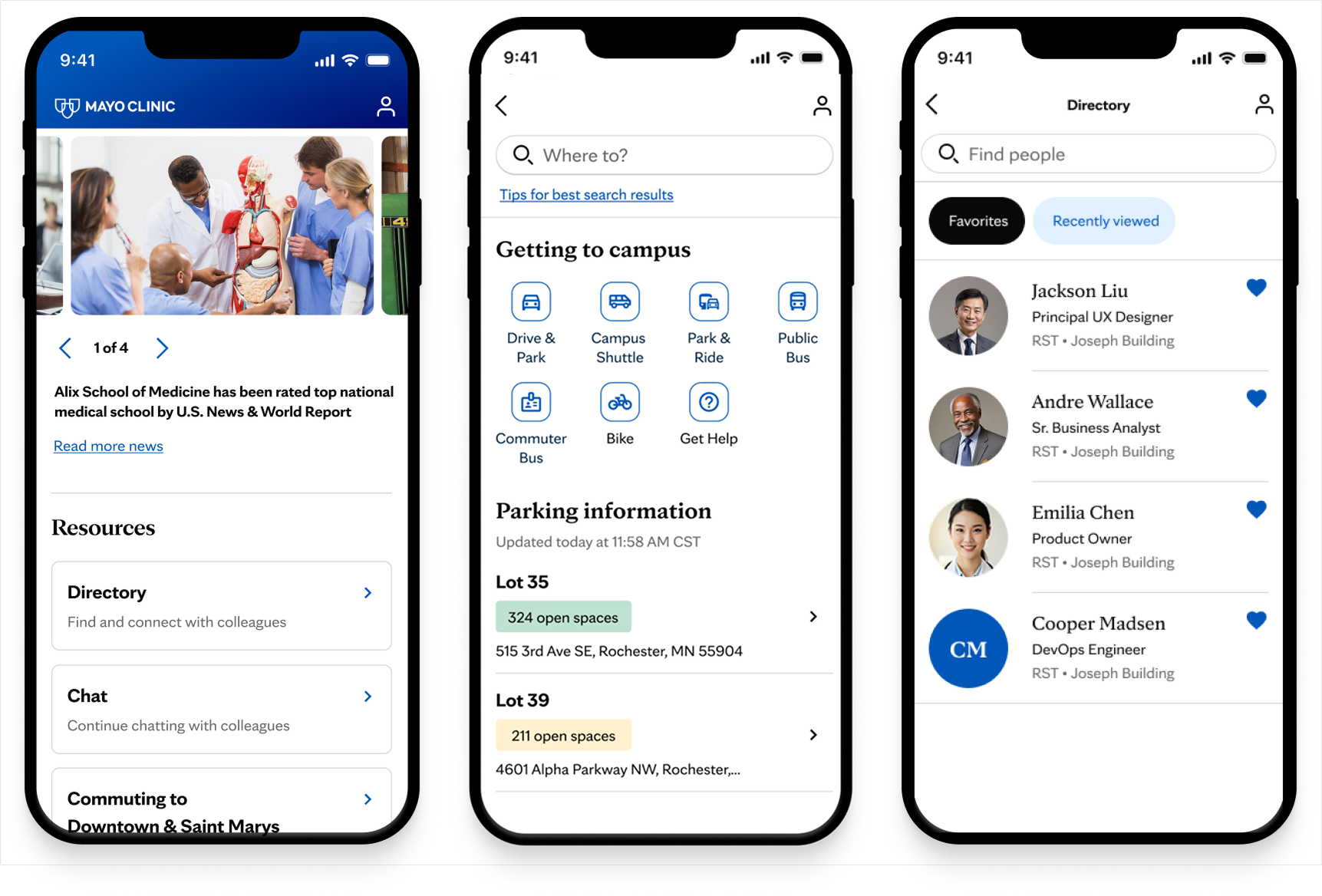
Select screens from the Care Team Navigator employee mobile app experience
Role
Product Designer
Overview
Care Team Navigator is a dual-purpose application designed to serve two distinct audiences: physicians and employees.
For physicians, the platform leverages AI to help clinicians quickly review, understand, and summarize complex patient records, enabling more informed care decisions. For employees, Care Team Navigator simplifies the daily commute by providing real-time information about traffic, construction, parking availability, and campus navigation.
As a Product Designer on the team, I helped shape experiences for both physicians and employees, creating intuitive workflows tailored to the unique needs of each user group while maintaining a cohesive product experience.
The Challenge
Although physicians and employees had very different goals, both groups faced a similar challenge: an overwhelming amount of information that needed to be translated into clear, actionable insights.
Physician Experience
Clinicians often need to review large, complex patient records that contain years of documentation, test results, and notes from multiple providers. Finding relevant information quickly can be time-consuming, reducing the time available for patient care and decision-making.
Employee Experience
Employees commuting to campus must navigate changing conditions such as traffic, construction, and parking availability while ensuring they arrive on time. Accessing this information often requires consulting multiple systems and sources throughout the day.
The challenge was to design experiences that reduced information overload, surfaced the most relevant insights, and helped users make confident decisions more efficiently.
My Contribution
As a Product Designer on the team, I partnered with product managers, engineers, clinicians, and employees to help define and design experiences across both sides of the application.
My responsibilities included:
Gathering and synthesizing user and stakeholder requirements
Mapping user journeys and workflows
Identifying usability challenges and opportunity areas
Designing AI-assisted clinician experiences
Creating wireframes, visual designs, and interactive prototypes
Facilitating stakeholder reviews and incorporating feedback
Ensuring consistency through design system adoption
Supporting development and quality assurance throughout implementation
Design Approach
Designing for two distinct audiences required a deep understanding of their goals, workflows, and decision-making processes.
For clinicians, the focus was on reducing cognitive load and helping them quickly understand complex medical information. We explored how AI could surface relevant insights, summarize records, and support clinical workflows without disrupting established care practices.
For employees, the emphasis was on providing timely, contextual information that supported daily commuting decisions. The experience was designed to help users quickly understand current conditions and take action with minimal effort.
Across both experiences, we prioritized:
Simplicity and clarity in information presentation
Consistent design patterns and interactions
Trustworthy AI interactions
Accessibility and usability best practices
Scalable design system components
Efficient developer handoff and implementation processes
Regular collaboration with physicians, care teams, and employees ensured that design decisions remained grounded in real user needs.
Early stage interactive mobile prototype of a clinical consultation view featuring an AI-generated clinical summary, quick search, patient demographics and AI-assisted report requests.
The Solution
Care Team Navigator delivers tailored experiences for two distinct audiences within a unified platform.
Physician Experience
The physician-facing application uses AI to help clinicians:
Review and summarize patient records more efficiently
Surface critical information and insights
Access important patient data, including test results and clinical documentation
Reduce time spent searching through large volumes of information
Employee Experience
The employee-facing application helps staff:
Plan their commute more effectively
Monitor traffic and construction impacts
Locate available parking
Navigate campus more efficiently
Arrive at work on time with greater confidence
By delivering relevant information in a concise and actionable format, both experiences help users spend less time searching and more time focusing on their primary goals.
Outcome
Care Team Navigator demonstrated how thoughtful UX design and AI can transform information-heavy experiences into intuitive, user-centered workflows.
For clinicians, the platform streamlined access to patient information, helping them spend less time navigating records and more time focusing on care decisions.
For employees, the application simplified daily commuting by bringing critical travel and parking information into a single experience.
This project strengthened my expertise in designing AI-enabled experiences, balancing the needs of multiple user groups within a single product ecosystem, and creating scalable solutions that support both operational efficiency and exceptional user experiences.